How the Yandex Direct auction works
Yandex Direct is a service for placing search and content ads. You pay for clicks on ads served on placements in Yandex Search and ad networks (Yandex Advertising Network and ad exchanges).
The cost of a click in Yandex Direct is not fixed — it's based on the results of an auction among advertisers. Advertisers set bids in a currency, but Yandex Direct internal units are used for auctions. Bids are converted into internal units in real time. Conversion takes place in accordance with the Russia's Central Bank's exchange rate for the given currency on the current day.
The auction takes place in real time when the user is loading a search results page or a page containing ad units from the Yandex Advertising Network or ad exchanges. The auction consists of a few steps.
Ad selection and ranking
Each ad unit on the page that the user opens gets its own set of ads. Ads are ranked based on a combination of the bid, quality coefficient, and CTR forecast for that specific impression. The ad with the best combination of indicators ends up in the placement section.
Determining the click price
The click price varies with placement:
-
Yandex search and YAN search platforms use VCG auction rules.
-
YAN content platforms and ad exchanges use GSP auction rules.
VCG auction
VCG auction rules are used to determine the click price in Yandex search results and on YAN search sites. Here we'll describe how the click price is calculated for the Premium placement.
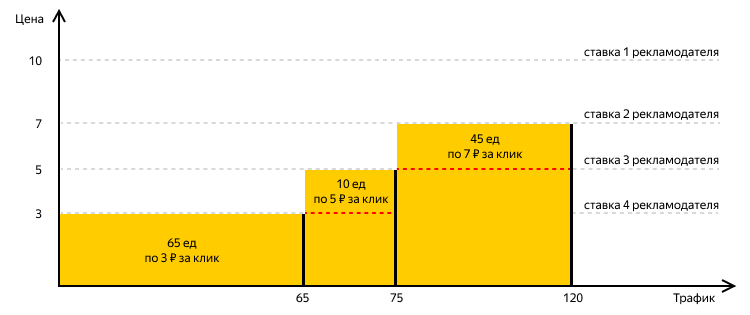
Depending on the competition for a specific search query, the ad unit can serve between 0 and 4 ads. If there are 4 positions in premium placement, then the first position will bring in a traffic volume of 100 units, and second, third, and fourth positions will bring in a volume of 85, 75 and 65 units respectively. Traffic volume is a value directly related to the CTR of an ad position. This is not consistent and is calculated for each concrete query. The traffic volume calculation factors in the ad design, number of ads in a unit and their designs, and the ad display position on search.
If there are five ads with the same quality coefficients and CTR forecast values, and they are competing for 4 premium placement impressions (in non-expanded formats) with bids of 10, 7, 5, 3 and 2 RUB respectively for the keyword in question, then the ads with the highest bids will be served in the section. The number of clicks on ads and the average cost of such clicks will depend on the advertiser’s location in the section:
- Each of the four advertisers who won a spot in the section will get a traffic volume of 65 units. Advertisers don't have to compete for this baseline level of traffic. The price for this minimum amount of traffic is determined by the bid of the fifth competitor who didn't make it into the ad unit (in this case, ₽2 per click).
- The three advertisers with the highest bids are guaranteed to get the additional 10 units of traffic volume (compared to the advertiser in the fourth position). The fourth advertiser competes with them in the auction for these clicks. In this example, the fourth advertiser's bid of ₽3 determines the cost for this additional amount of traffic.
- The additional 10 units of traffic allow the advertiser to move up from third place to second place (the two advertisers with the highest bids are guaranteed to get this traffic). In this case, the third advertiser's bid determines the actual competition for this additional traffic. The third advertiser's bid of ₽5 determines the price for that additional traffic volume.
- The first position brings in an additional 15 units of traffic. The competition with the 2nd place advertiser, who bid ₽7, determines the price.
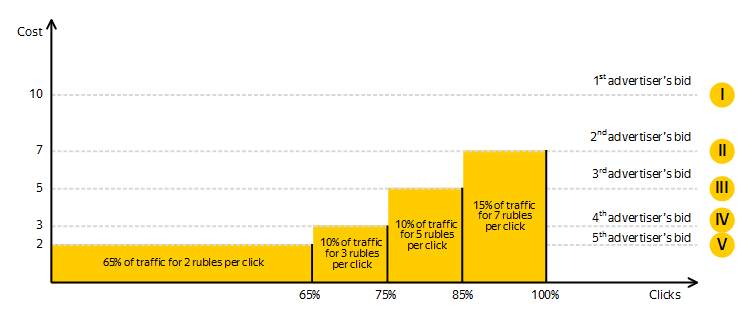
Bids are not calculated separately based on whether a click is "baseline" or "additional". Instead, Yandex Direct calculates the average bid based on the principle that the main share of traffic shouldn't get more expensive when an ad gets a more prominent placement. When calculating the click price, Yandex Direct uses the CTR coefficients for display positions. This coefficient is not constant; it changes over time and in relation to different search terms.
How click price (CPC) is calculated
If an ad unit has 4 placements with CTR values of X1, X2, X3, and X4, and 5 ads compete for this ad unit (with ad bids of Bid1 ... Bid5, where the CTR forecast for that given impression of these ads is CTR1 ... CTR5 respectively), the click price is calculated using the following formulas:
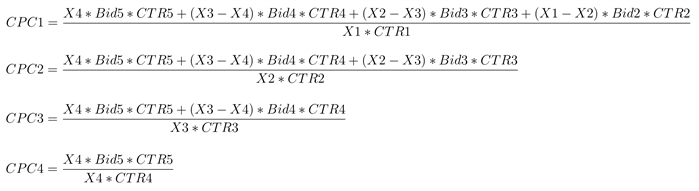
The CTR forecast for ads in the ad unit will be used to calculate the click price. If bids and quality coefficients are the same across all ads, then the ad with the highest CTR forecast will get the top position.
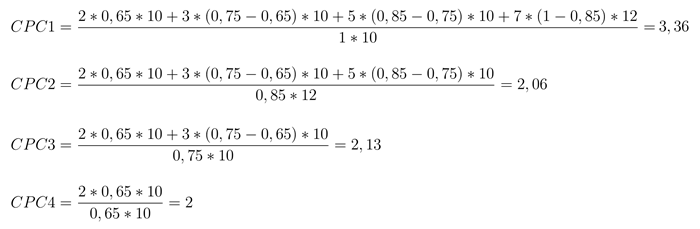
The four placements in the ad unit have the following CTR values: X1 = 1, X2 = 0.85, X3 = 0.75, X4 = 0.65. 5 ads are competing in the auction with the bids of ₽10, ₽7, ₽5, ₽3, and ₽2. Ad CTR forecasts for this impression are CTR1 = CTR3 = CTR4 = CTR5 = 10%, CTR2 = 12%, with all quality coefficients being equal.
VCG auction for the expanded format
In the premium placement, ads can be served in the expanded format (in the top position) and in the minimalistic format (in the second and third positions). The format selected depends on the advertisers' bids and coefficients calculated for different formats.
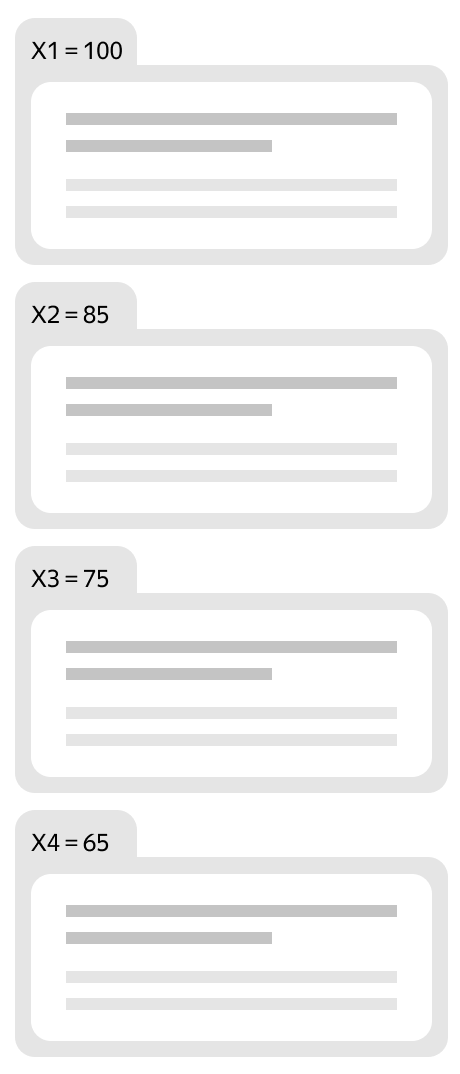
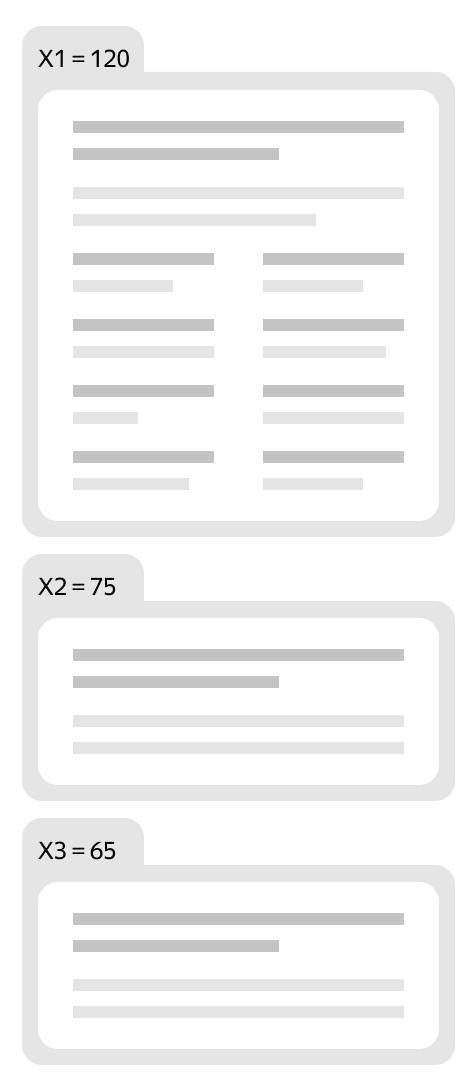
The expanded format gives 20 more units of traffic to Advertiser A at the expense of taking 10 units from both Advertisers B and C. The fourth advertiser is excluded from impressions.
| Regular placement section | Expanded format |
|---|---|
 |
 |
The expanded format will be selected when the condition is met (we omitted quality coefficients for the sake of simplicity):

The click price is calculated similarly to the premium placement unit without the extended format. The competition for each additional traffic tier affects its cost.
GSP auction
GSP auction rules are used to determine the click price on YAN content sites and on ad exchanges. The click price is determined by the bid set by the closest competitor. For example, if the ad unit can host only one ad, the click price for the auction winner is equal to the bid of the participant who took second place.
Let's take a look at how CPC is determined for an ad unit that can host multiple ads.
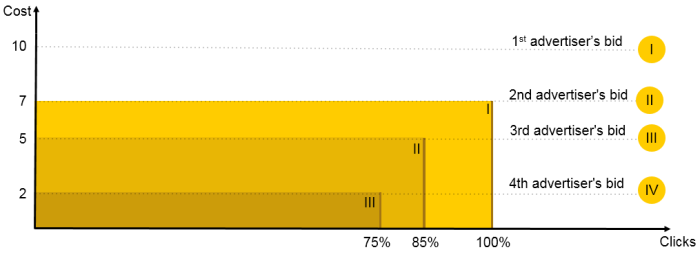
Four ads compete for impressions in an ad unit that fits only three (so, there are three positions). The bids are 10, 7, 5, and 2 rubles respectively, and their quality coefficients and CTR forecasts are all the same. Let's assume that the first position in the ad unit draws the most traffic, while the second and third positions get 85% and 75% of the maximum possible traffic, respectively.
The first ad will get the first position. It will get the maximum possible traffic for the given search query. Every click on that ad will cost 7 rubles.
The second will get 85% of the maximum possible traffic for 5 rubles per click.
The third will get traffic for the minimum price of 2 rubles per click, but this still amounts to 75% of the maximum possible traffic for ads served for that search query.
Have questions?
Alert
Our customer support can only assist you with campaigns linked to the username you are contacting us from. You can check your username by opening ya.ru in another browser tab. Our team can access your data only when processing your request.
Scan the QR code or tap it to follow the link.


If you select Telegram or WhatsApp, keep in mind that Yandex does not control and is not liable for how third-party messengers store your data and chat history.