Feed
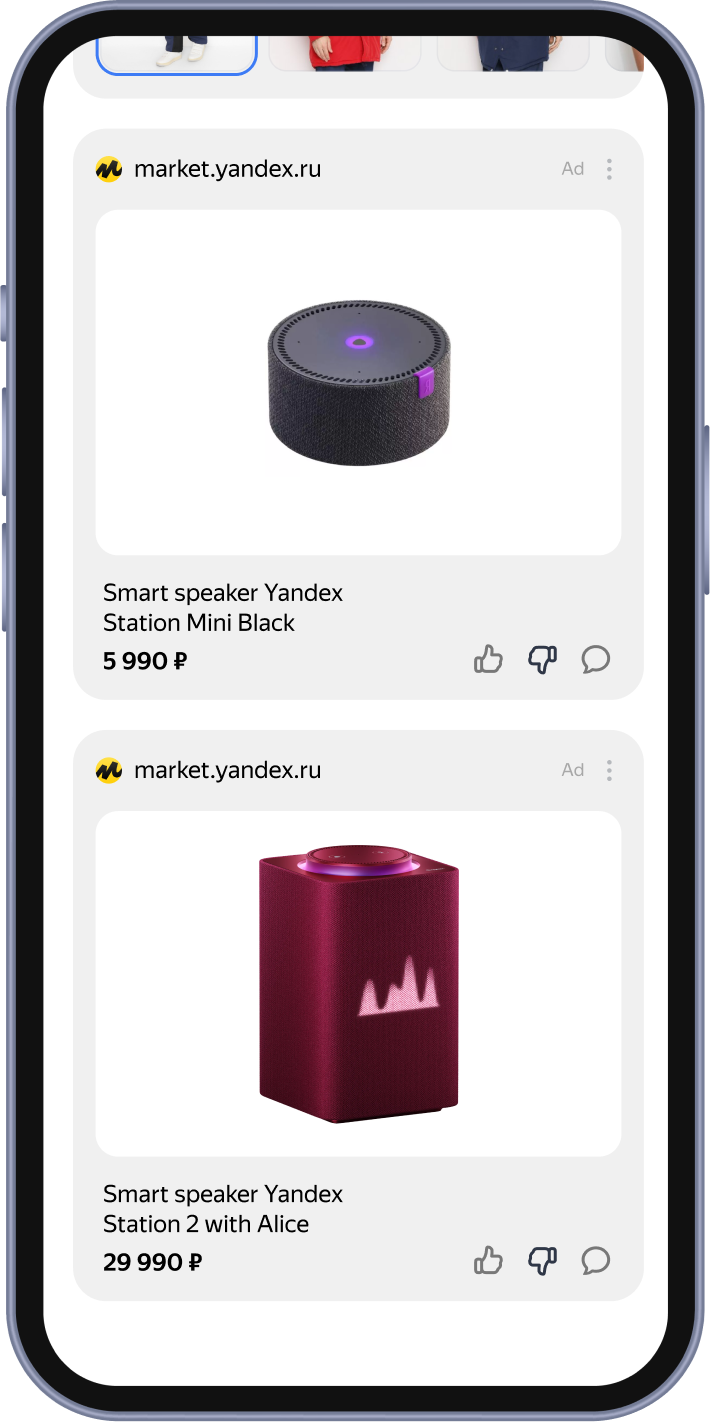
The feed is an ad unit that consists of a sequence of Adaptive combinatorial ads.
For this ad unit type, Yandex has developed special algorithms that select the most visually attractive ads, motivating the user to look through the feed and follow the ad links. The feed displays several product ads at a time, which is one of the reasons it may be more effective than other ad formats.
The number of ads may differ in the mobile and desktop versions of a site. In the desktop version, ads are divided into multiple columns depending on the screen width.
Unit sizes
-
Number of columns: 1.
-
Minimum ad width: 220 pixels. The feed isn't displayed if the width of the container is too small.
-
Number of columns: 1–5, depending on the screen width.
-
Minimum ad width: 300 pixels.
-
The maximum width of the ad depends on the width of the screen:
- 1–2 columns: 535 pixels.
- 3–5 columns: 440 pixels.
Sample feed with an adaptive SD ad
How to add a Feed
-
In the Yandex Advertising Network interface, go to Website Ads → Ad units and click New ad unit.
-
Select the site that you want to create an ad unit for and click More.
-
Select the Feed unit type.
-
Enter a unit name to be used in the Yandex Advertising Network interface.
-
Set up the unit's general settings in the General tab.
-
Select a CPM strategy:
-
Maximum revenue: Determine the minimum cost of impressions automatically. With this option, you can effectively fill placements and maximize revenue for the site owner.
-
CPMV threshold: Set your own minimum cost per thousand impressions based on a viewability check. The CPMV floor can be set in rubles, US dollars, or euros. You can change the floor currency in your account settings.
Alert
Setting a CPMV floor can reduce the unit fill rate and, therefore, decrease your income.
-
-
To display the ad unit on both desktop and mobile versions of your site, leave the Ad unit for AMP field set to No.
Note
The same unit can be placed on desktop and mobile versions of the site: it will be displayed on all devices.
-
Choose a theme: Dark or Light. The default option is Light theme. Dark theme units have a different background and color scheme for their text, border, buttons, and other elements. The selected theme applies to all ad formats within the unit.
-
-
Configure the recommendations if you want the user to see your site publications in the ad unit. To do this, in the Recommendations tab:
-
Enable the Show content recommendations option.
-
Adjust the slider to set the number of recommendations in the feed.
-
Under Recommendation settings, set up the parameters for all the publications to be loaded into the ad unit:
-
Metrics for optimization: Select a method for the algorithm to select recommendations:
- CTR: The algorithm will maximize clicks from the ad unit to the publication.
- Long clicks: The algorithm will maximize both clicks from the ad unit and the duration of the site session following the click.
Note
In both cases, the recommendations are tailored to the users' interests. Recommendations are also influenced by the topic of the page that displays the ad unit.
-
Filter read: Enable this option if you want to filter out the publications that the user already saw. Our algorithm uses machine learning by default, which helps it determine if a user should see content they've already seen or not. Multiple factors are considered before a choice is made. We do not recommend enabling this option. Our experiments show that machine learning handles filtering more effectively.
-
Use only image creatives: Disable this option if you want to load publications both with and without images in the ad unit.
Note
This option doesn't apply to ads. The display of images in ad slots depends on the site settings.
-
The age of the documents is not more than: If the articles you post become outdated after a while (for example, news), you can specify the number of days that should pass from the date of publication before they are no longer displayed in the ad unit.
-
-
Under Blocked documents, add up to 300 links to publications that you do not want to display in the ad unit. Once you add a document to this section, it's blocked for 30 days.
-
Click Add source and enter the domain that hosts the publications you want to load into the ad unit. The domain must match one of your sites or be specified in its mirrors. The site doesn't have to be the one where you're adding the ad unit.
Alert
You also don't need to specify the address protocol (HTTP, HTTPS).
-
Set your filter parameters:
-
Allowed tags: If you've added tags to your site pages, you can filter publications by the tags. List the tags for the publications you want to display in the ad unit, then press Enter.
-
Prohibited tags: List the tags for the publications you don't want to display in the ad unit.
Tip
After the tags are added to your site's pages, you should wait a few days before using them to filter content. This gives the robot some time to crawl these pages and receive the necessary information about the tags. Otherwise, there might not be many recommendations for the ad unit to show.
-
Allowed sections of site: Enter the path to the site sections you want to load into the ad unit. Specify the path from the root directory of your site preceded by the
/symbol. The maximum path length is 128 characters. -
Prohibited sections of the site: Use this parameter if you want to blacklist publications on certain sections of your site from showing up in the ad unit, entering the paths to them in this field (leave the Allowed sections of site field empty). The maximum path length is 128 characters.
-
-
You can add more domains if necessary (10 max).
-
-
Choose how you want to configure ad formats:
-
Use standard settings: Automatically determined design and ads impression parameters.
-
Configure the formats: With this option, you can test how Adaptive ads will display on different devices:
-
Open the card with base design.
-
In the preview area, choose between the desktop or mobile device using the
 option.
 -
Configure the container size in the Container field: you can select a value from the list or set the size yourself by selecting Custom.
Note
The specified container size is used only to generate the preview area and isn't saved in the unit settings.
-
-
-
Click Create. A window with the ad tag will open. Use this ad tag to place the ad unit on your site.
Once you save the ad unit, it will be assigned a unique identifier (ID). It consists of a product ID (R-A), site ID (site_id), and the unit's serial number.
How to add a Feed to your site
-
Get the ad tag: create a new unit or click Get code in the settings of an existing unit.
-
Copy the Yandex Advertising Network loader code to the clipboard and paste it inside the
<head>tag on the page where you want to display the feed. The loader code is only embedded on the page once and is used to call all Yandex Advertising Network units. -
Copy the ad unit code to your clipboard and add it to the
<body>of the page.Alert
When placing a feed on pages with Floor Ad or Top Ad units, be sure to configure the deletion of these units when the feed becomes visible. The ad unit placement requirements prohibit displaying a Feed and a Floor Ad or Top Ad on the same screen.
How we calculate feed impressions
Impressions and viewable impressions are counted for every three ads in the feed:
-
Viewable impressions are counted if at least 50% of a three-ad unit is in the visible screen area for two seconds or more. If the unit is too large, at least 30% of the unit must be in the visible screen area.
For example, if the user sees 9 ads in the feed, this counts as 3 viewable impressions in the statistics. If the user sees 10 ads, this also counts as 3 viewable impressions. However, 11 ads count as 4 viewable impressions.
-
Impressions for 3 ads are counted if at least one pixel of the unit is in the visible screen area.
Contact support
Write to WhatsApp
|
Scan the QR code. WhatsApp is a third-party channel for communication with Yandex. We do not control and are not liable for how WhatsApp stores your data and chat history. Please keep this in mind when choosing WhatsApp to contact support. |
WhatsApp is a third-party channel for communication with Yandex. We do not control and are not liable for how WhatsApp stores your data and chat history. Please keep this in mind when choosing WhatsApp to contact support.
Go to WhatsAppWrite to Telegram
|
Scan the QR code. Telegram is a third-party channel for communication with Yandex. We do not control and are not liable for how Telegram stores your data and chat history. Please keep this in mind when choosing Telegram to contact support. |
Telegram is a third-party channel for communication with Yandex. We do not control and are not liable for how Telegram stores your data and chat history. Please keep this in mind when choosing Telegram to contact support.
Go to TelegramYou can also go to

An impression is considered viewable if at least 50% of the unit area shows on the screen for at least two seconds.